

Social Media Monitoring Tools: How They Can Help Your Business
Social media monitoring tools track what people publicly say about your brand, competitors and market across social media, then turn that raw conversation into something a business can act on.
Done well, that is the difference between having a vague sense that “people seem unhappy” and knowing which narrative started it, where, in what language, and how fast it is spreading.
The category has been around for a decade. What has changed is what people post. The conversation moved to video, and most tools did not follow.
What does a social media monitoring tool actually do?
A social media monitoring tool runs four jobs continuously:
- Collect. Track keywords, hashtags and specific accounts across platforms, reading new public posts and re-checking engagement on posts already seen.
- Understand. Work out what each post is about: sentiment, topic, language, whether it is news, commentary or promotion, and whether it is genuinely relevant or just a keyword collision.
- Aggregate. Group related posts into themes, so you read a handful of narratives instead of ten thousand individual posts.
- Alert. Surface the things that need a human: a spike, a shift in tone, a story crossing from one platform to another.
The first job is a data engineering problem. The other three are where tools differ enormously.
What can a business do with social media monitoring?
Five uses account for most of the value:
- Reputation awareness. Know that a complaint is spreading while it is still one thread, not after it reaches the press.
- Competitive intelligence. See what customers say about competitors, including the complaints those competitors are not publishing.
- Campaign measurement. Measure what people said back, not just impressions delivered.
- Product and market signals. Recurring feature requests, unmet needs and workarounds surface in public long before they reach a survey.
- Crisis detection. Detect coordinated or unusual activity early enough that the response is a decision rather than a scramble.
Why video is the hard part
Most social media monitoring tools were built when social media was text. They index the caption, the hashtags and the comment thread. When the post is a three-minute TikTok, a Reel or a YouTube Short, the caption might be nine words and an emoji, and the substance, the argument, the claim being made, all of it lives in the audio the tool never listened to.
This is now the majority of the problem. On the platforms where public opinion actually forms, video is the default format, and a tool that reads captions is reading the label on the box.
Vigil was built the other way around. Every video post it monitors is transcribed with speaker separation, timed subtitles and full English translation, so spoken content becomes searchable, filterable text like any other post. An analyst reads a transcript in thirty seconds instead of watching a video for three minutes, and can search across ten thousand of them.
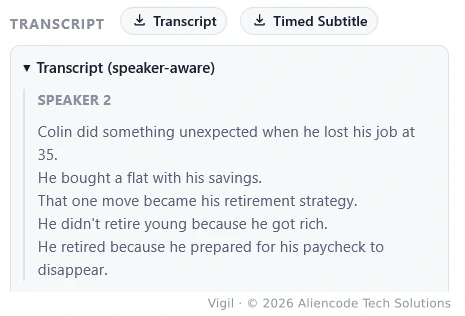
The spoken content of a video, separated by speaker and downloadable as text or timed subtitles.
Speaker separation matters more than it sounds. A three-way discussion where one speaker makes a claim and the other two push back is a completely different post from one where all three agree, and a tool that flattens it into a single block of text cannot tell you which you are looking at.
That transcription then feeds everything downstream. Because the words are available, Vigil can summarise what a video actually said, classify it against the real argument rather than the caption, and cluster related posts into narratives that can be tracked as they develop.
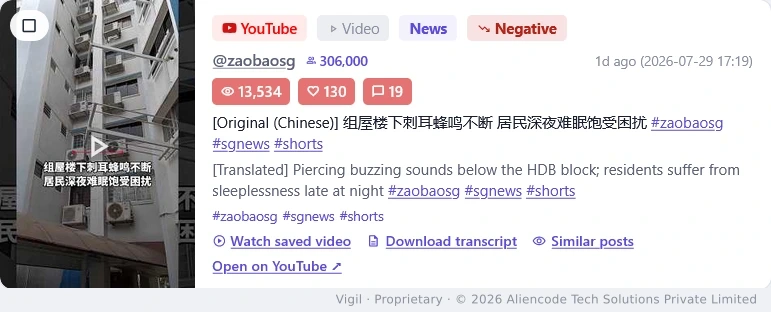
One monitored post: original language, English translation, engagement at last reading, and the saved video and transcript kept alongside it.
Language matters here as much as format. In a market like Singapore, a tool that handles English well and everything else through machine-translated captions is showing you an English-speaking slice of the conversation and calling it the conversation. Vigil transcribes and translates the languages and dialects this region actually posts in, and reads them natively rather than through a translated caption.
Reading the network, not just the posts
Volume and sentiment tell you what is being said. They do not tell you whether five hundred posts represent five hundred opinions or one campaign with five hundred accounts.
That question is a structural one rather than a volume one. Whether a story is spreading the way stories normally spread, or whether its shape looks like something else.
Vigil surfaces signals that speak to it, and puts them to an analyst rather than reaching a verdict itself. That distinction is deliberate: a tool that declares a campaign is a tool that can be wrong in public on your behalf, and the judgement belongs with your team.
We do not publish screenshots of that view, or a list of what feeds it. It is the part of the product we would rather demonstrate directly than photograph.
What to look for when choosing a social media monitoring tool
| Question to ask | Why it matters |
|---|---|
| Does it transcribe video, or only read captions? | On platforms where most posts are video, caption-only coverage misses most of the actual content. |
| Which languages does it natively transcribe? | Machine-translating a caption is not the same as understanding the spoken content. |
| How often does it refresh? | A daily digest is a historical record. Sub-hour refresh is an early warning. |
| What happens when a post comes down? | A narrative you are halfway through analysing should not develop a hole because one post was removed. |
| Does it cluster into narratives? | Keyword volume tells you something moved. Narratives tell you what it was. |
| Can it show coordination signals? | Distinguishing organic reach from coordinated amplification changes the response. |
| Can your team manage topics themselves? | If every keyword change is a support ticket, the tool will go stale. |
| Where does the data live? | Data residency is a procurement requirement long before it is a preference. |
Where to start
If you are evaluating tools, the fastest way to separate them is to pick one genuinely video-heavy, multilingual topic in your market and ask each vendor to show it to you on live data. Caption-only coverage becomes obvious within a minute.
If you would like to see that run on a topic that matters to you, we will set one up. Contact us and tell us the topic, or read more about Vigil first.